


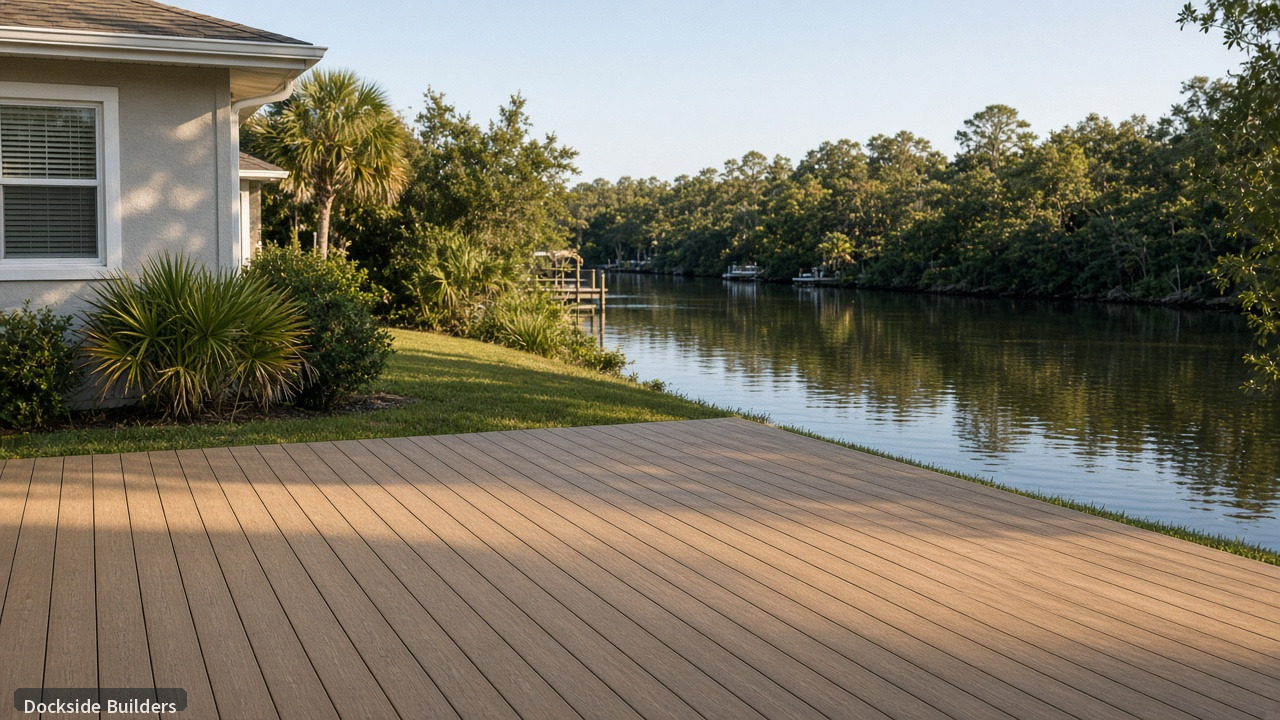
Short answer: For a Florida waterfront deck, capped composite usually outperforms traditional wood on day-to-day upkeep, splinters and moisture-related wear. Dockside Builders, based in Sebastian, uses only superior, premium materials on customer projects. We work with only the best distributors — our partners — for capped composite on many waterfront decks. For a dedicated dock, our partners typically recommend PVC decking rather than composite.
Key takeaways:
- Wood can look beautiful when it is new, but Florida sun, salt and humidity mean regular sealing, staining and repairs.
- Capped composite from our partners mixes polymers with wood fibers and adds a protective cap. It is made to look like wood and typically does not need sanding, staining or sealing — just occasional cleaning.
- Dockside Builders uses only superior, premium materials on customer projects. That standard is why we install capped composite from our partners on many waterfront decks.
- The composite lines we install typically carry manufacturer-backed limited warranties, often 25 to 30 years. Those warranties have conditions and are not a promise of a set lifetime.
- Composite can get hot in direct sun; lighter colors help. For a dock over the water, our partners typically recommend PVC decking rather than composite.
What is the difference between wood and composite decking?
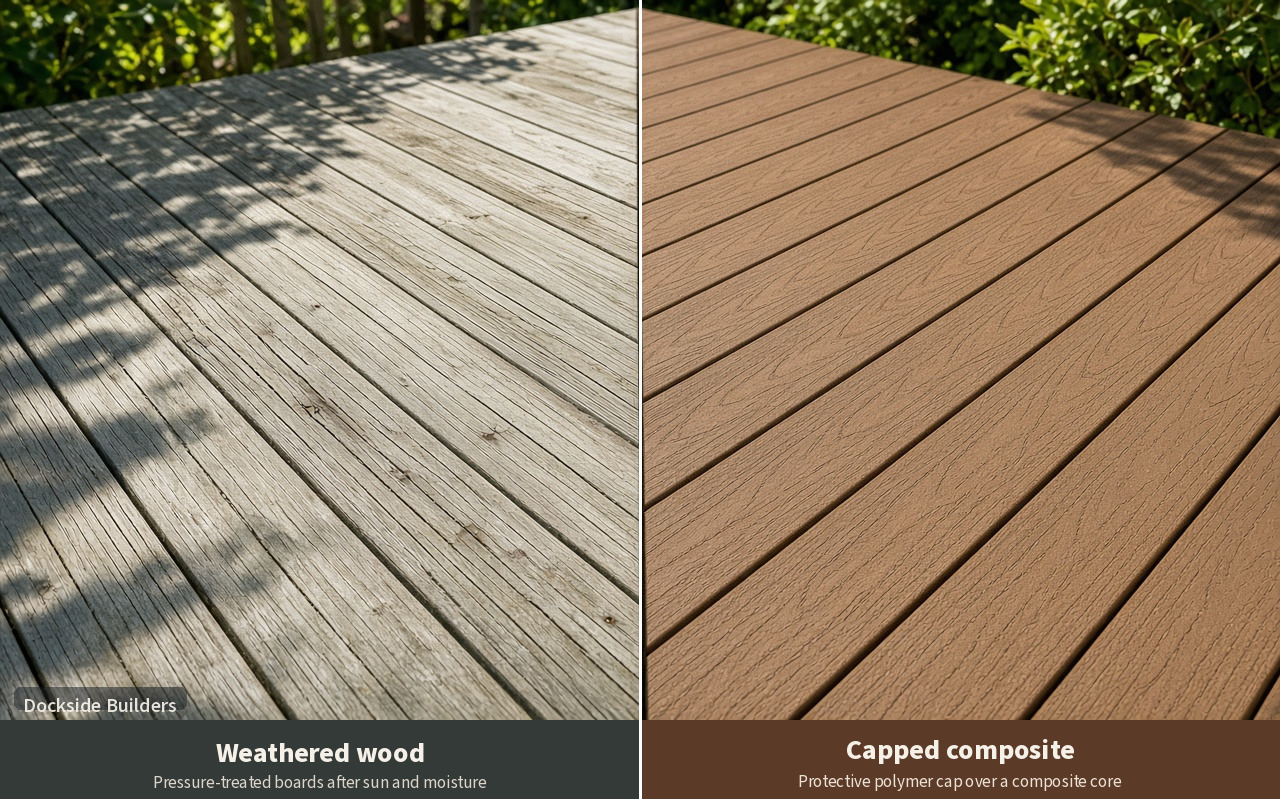
Wood decking is traditional lumber that needs regular finishing and is more exposed to Florida moisture, insects and sun. Capped composite from our partners mixes polymers with wood fibers and covers the board with a protective polymer cap. It is made to look like wood while reducing the upkeep wood requires.
Manufacturers typically describe capped composite as resisting splinters, cracking, cupping and peeling, with occasional cleaning instead of sanding, staining or sealing. Those are manufacturer descriptions, and the boards still need correct installation and ordinary care. Wood remains a familiar option, but it asks more of a coastal homeowner over time.
Why does Florida's waterfront climate matter?
A Florida waterfront deck takes strong sun, humidity and often salt air along the Treasure and Space Coasts. That mix is hard on wood, which can gray, check and invite mold or rot if finishing falls behind. Capped composite is designed to handle moisture and UV better, so many Sebastian-area homeowners choose it for decks near the water.
Dockside Builders has been building on this shoreline since 1980. We see the same pattern on canals, the Indian River Lagoon and Intracoastal lots from the Daytona area south toward Palm Beach County: the material has to handle wet air and hard light, not just look good on install day.
How do wood and composite decking compare?
The biggest everyday differences are upkeep and wear. Wood usually costs less at the start but needs repeated sealing or staining. Capped composite from our partners typically costs more upfront; lower maintenance can make it more cost-effective over time. We do not publish dollar ranges here because installed prices depend on the site, the product and the structure.
| Wood decking | Capped composite | |
|---|---|---|
| Upkeep | Regular sealing, staining or painting, plus repairs for splits and rot | Typically no sanding, staining or sealing; occasional scrub and rinse |
| Splinters and surface wear | Can splinter, check and cup as it weathers | Manufacturers typically say the boards resist splinters, cracking, cupping and peeling |
| Moisture and insects | Vulnerable to rot, mold and insects if not maintained | Protective cap is made to resist moisture, mold, mildew and rot; the core still contains wood fibers |
| Heat in the sun | Can get hot; comfort varies by species and color | May get hot in direct sun, especially on very hot days; lighter colors help |
| Warranty / stated life | No comparable manufacturer fade-and-stain warranty; life varies with species, exposure and care | Manufacturer-backed limited warranties, often 25 to 30 years |
| Upfront cost | Typically lower at installation; ongoing finishing adds cost | Typically higher at installation; lower upkeep can improve long-term value |
Warranty figures are limited warranties, not a promise that every board lasts exactly 25 or 30 years. Always read the current manufacturer warranty for terms, exclusions and care requirements.
What materials does Dockside Builders use?
Dockside Builders uses only superior, premium materials on customer projects. We work with only the best distributors — our partners. We specify products we trust to stand up to Florida sun, salt and humidity, then install them as part of a plan that fits the property — the water, the structure and how the family will use the space.
We will not cut material quality to shave a bid. If a surface should be a waterfront deck, we look to a premium capped composite from our partners. If the work is a dedicated dock, we follow our partners' guidance and use a material made for that application. The structure, fasteners and finish details are chosen for the site, not from a generic package.
Why capped composite from our partners for a Florida waterfront deck?
Dockside installs capped composite from our partners because it gives us a wood look, a protective cap, manufacturer-backed limited warranties and a range of grain patterns and colors that suit coastal homes. It is a strong match for decks near the water.
Some boards have a protective cap on three sides, others on all four, which offers more complete coverage of the board. We still treat a dock as a different job, as explained below.
What colors and finishes are available?
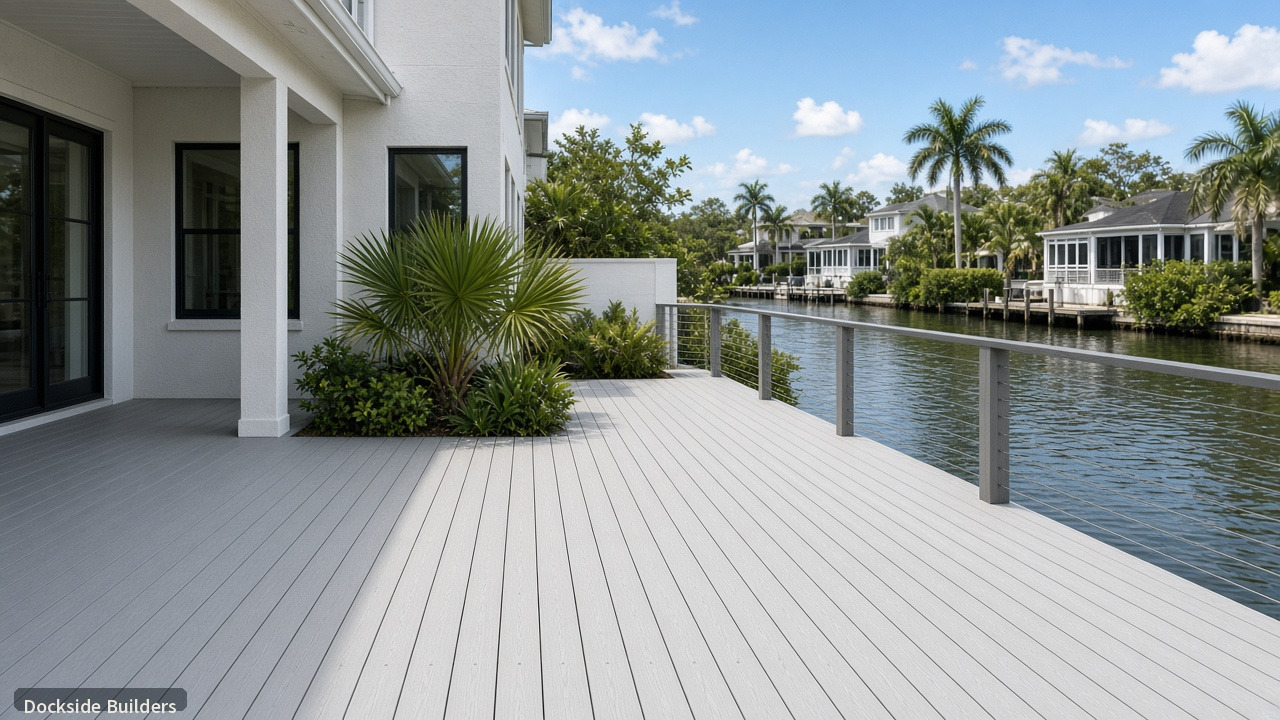
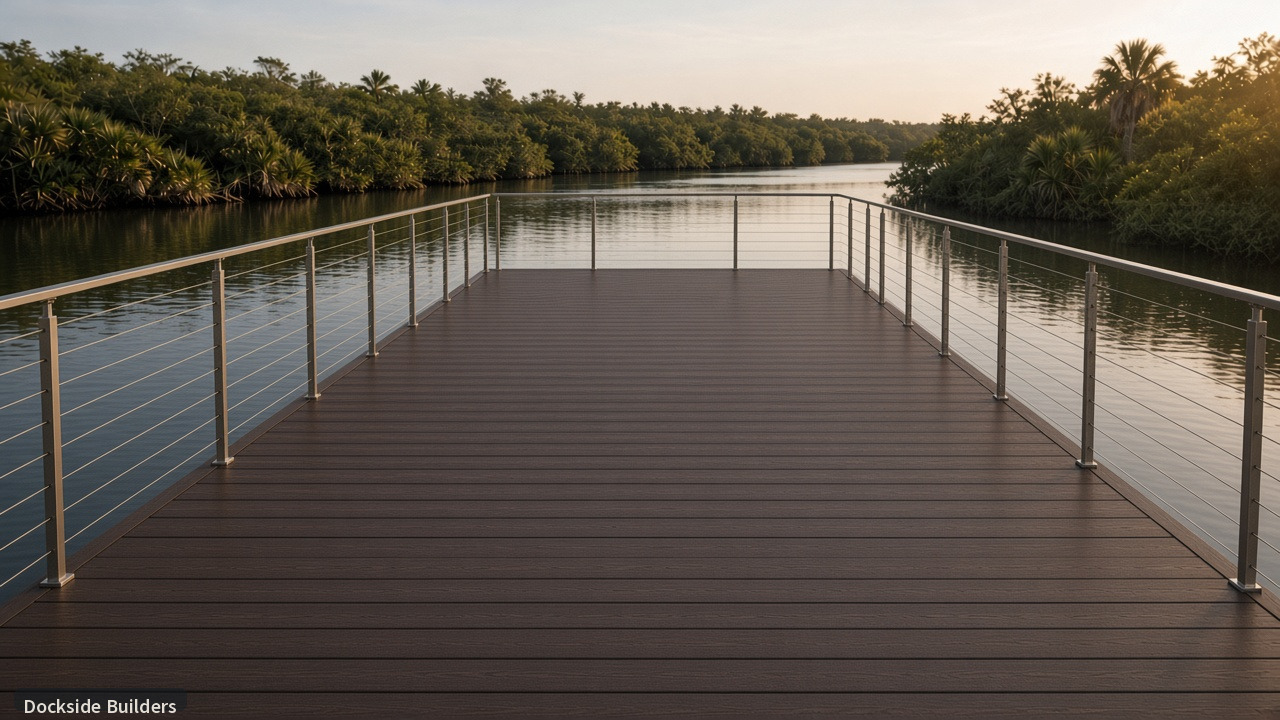
Our partners offer capped composite in a range of grain patterns and colors, from light coastal tones and weathered grays to warm browns and deep dark browns. Lighter tones are worth a close look on a full-sun Florida deck. We confirm local inventory, lengths and profiles before a build is finalized.

Is composite a good choice for a dock or only for a deck?
For a deck beside the water, yes. Capped composite from our partners is a dependable choice near lakefronts, pools and other wet areas. See a composite community dock re-deck in Vero Beach and the composite re-deck of a dock, stairs and upper deck on John's Island. Premium capped composite was also used on our Snug Harbor dock, dual boat lifts and tiki hut. For a dedicated dock, our partners typically recommend PVC decking rather than composite. Dockside follows that distinction and treats a deck and a dock as two different applications.
The distinction is practical. Composite still has wood fibers in the core. PVC decking contains no wood and is made for moisture-rich, coastal settings. Dockside will help you match the material to the structure: composite for many waterfront decks, and a dock material that is actually specified for a dock. If both a deck and a dock are part of the same property, they do not have to be the same board.
Does composite decking get hot in the Florida sun?
Yes, it can. Composite may get hot under direct sunlight, especially on very hot days and lighter color choices help reduce heat buildup. Shade from a roof, a tiki hut or nearby trees also makes a difference on a Treasure Coast afternoon.
How do you care for a composite deck in Florida?
Keep it simple. Sweep or rinse off salt, sand, leaves and organic debris and wash with soap and water or a cleaner the manufacturer approves. You do not need to sand, stain or seal the boards. Follow the manufacturer's current care instructions and warranty terms rather than a generic pressure-washing routine.
Permitting for a new or replaced waterfront deck or dock depends on the property and whether work extends over the water. Once the plans are approved, Dockside handles paperwork submission to the relevant local and state agencies. For a broader overview, see Do I need a permit to build a dock in Florida?.
Frequently asked questions about wood vs. composite decking
Is composite or wood better for a Florida waterfront deck?
For most decks beside the water on the Treasure Coast and Space Coast, capped composite is the lower-maintenance choice. Wood can look beautiful at first but needs regular finishing in this climate. The right product still depends on the site and on whether the surface is a deck or a dedicated dock.
Does Dockside Builders use only premium materials?
Yes. Dockside Builders uses only superior, premium materials on customer projects. We work with only the best distributors — our partners — and that is why we install their capped composite on many waterfront decks from our shop in Sebastian, Florida.
Can you use composite decking on a dock?
Our partners typically recommend PVC decking, not composite, for dedicated docks. Capped composite is a good choice for decks, including decks near water. We follow that distinction and will help you match the material to the structure.
How long does capped composite last?
The composite lines we install typically carry manufacturer-backed limited warranties, often 25 to 30 years. Those warranties are limited, depend on proper installation and care and are not a blanket guarantee of a specific lifetime. Always read the current manufacturer warranty for terms.
Will a composite deck stay cool in Florida?
Not necessarily. Composite can get hot in direct sun. Lighter colors and shade help. If staying cooler underfoot is a top priority, ask us about the material options, including PVC decking from our partners.
Get a free estimate
If you are planning a new waterfront deck, a deck replacement, or a dock that should be built with the right marine material, request a free estimate or call Dockside Builders at 772-664-6798. You can also see our decks work and all of our marine construction services. Contact us anytime. We are at 9760 Primrose Drive, Sebastian, FL 32976 and can be reached at info@docksidebuilders.com.

